INTERNATIONAL SEMINAR
Event
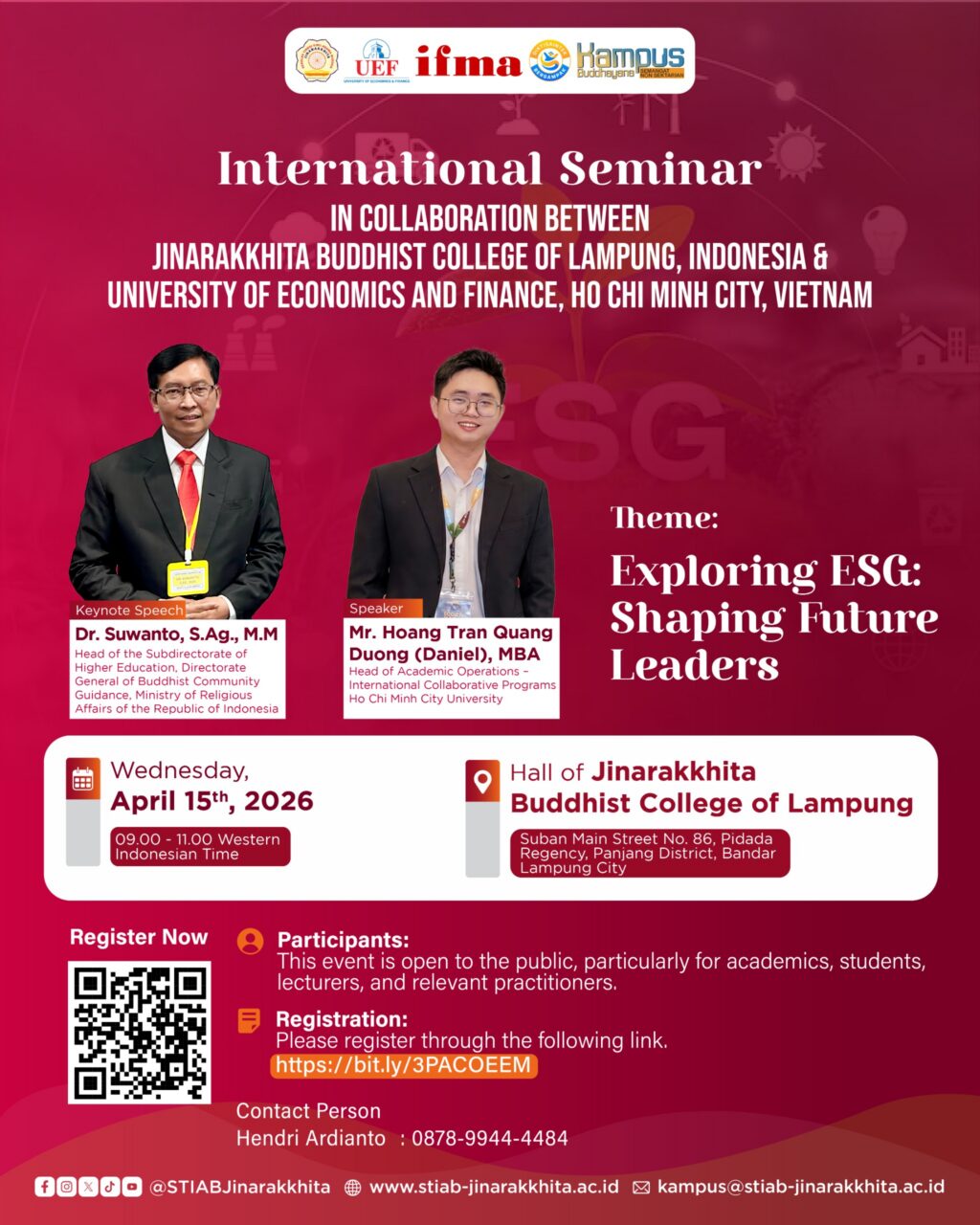
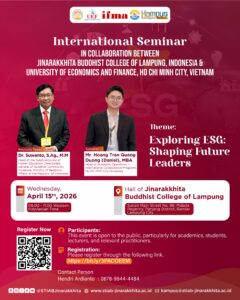
International Seminar: Exploring ESG: Shaping Future Leaders
Background
Global developments indicate that sustainability issues are increasingly becoming a primary focus across various strategic sectors, as reflected in the adoption of the Environmental, Social, and Governance (ESG) concept as a comprehensive framework. ESG is no longer viewed merely as a normative value but has become a key indicator in assessing organizational performance and sustainability at the international level. In the business world, companies are required to integrate environmental aspects, social responsibility, and transparent and accountable governance into their operational strategies. In the education sector, ESG principles are beginning to be incorporated into curricula and learning processes to foster a generation with critical awareness of global challenges. This need aligns with the demand for future leaders who are not only intellectually superior but also possess integrity, social responsibility, and a commitment to sustainability. ESG thus serves as a vital foundation for building a new paradigm that balances economic growth, social welfare, and environmental conservation in a sustainable manner.
Challenges in understanding and implementing ESG principles remain a real issue among the younger generation, particularly students, despite growing awareness of sustainability issues. Various studies indicate a gap between the level of understanding and actual practice. A 2025 study found that while 68.4% of young respondents demonstrated increased social concern and 63.2% felt more responsible toward the environment after receiving ESG education, only about 52.6% were truly committed to applying sustainable practices in their daily lives[1] . This data indicates that the internalization of ESG values has not yet fully translated into concrete behavior. On the other hand, recent reports also show fluctuations in young people’s interest in ESG, with support for ESG-based investments among young people experiencing a significant decline in 2024 compared to previous years[2] . This phenomenon is reinforced by various current global issues highlighted in the media, such as the climate crisis, social inequality, and greenwashing practices that fuel skepticism regarding the real-world implementation of ESG. Additionally, limited ESG literacy, the lack of integration into educational curricula, and a scarcity of practical experience serve as major barriers for students in comprehensively internalizing these values. This situation indicates that the younger generation still requires educational spaces, discussions, and real-world experiences capable of bridging the gap between conceptual understanding and the sustainable implementation of ESG.
These challenges are further reinforced by various empirical findings and current global dynamics that reveal inconsistencies between ESG awareness and implementation among the younger generation. A recent study published in an international journal in 2025 reveals that while environmental and sustainability awareness among the younger generation is relatively high, this does not automatically correlate with actual behavior, particularly in economic decision-making and investment[1] . Barriers such as risk perception, limited access to sustainable instruments, and the assumption that ESG practices entail high costs are the primary factors hindering implementation. On the other hand, PwC’s report in the Global Youth Outlook 2024 indicates that the younger generation actually possesses significant potential as agents of change due to their digital adaptability and awareness of global issues; however, they still require adequate support from the education system and ecosystem to actualize these values[2] . Current hot-button issues, such as growing skepticism toward greenwashing practices and a lack of corporate transparency regarding sustainability claims, further erode young people’s trust in the genuine implementation of ESG. This situation indicates that the challenges faced by students are not merely cognitive but also structural and contextual; therefore, a more applied, critical, and experience-based educational approach is needed to ensure that ESG principles can be internalized more effectively.
The role of higher education institutions is highly strategic in addressing these challenges, particularly in shaping the character and competencies of students as future leaders committed to sustainability. Higher education institutions serve not only as centers for the transfer of knowledge but also as agents of social transformation capable of systematically instilling ESG values through curricula, research, and community service activities. A report by Times Higher Education indicates that by 2024, over 2,152 universities from 125 countries were actively contributing to the achievement of the Sustainable Development Goals (SDGs), reflecting the global commitment of higher education institutions to integrating sustainability principles into education, research, and strategic partnerships[3] . This is reinforced by research findings stating that higher levels of education have a positive correlation with improved ESG performance within organizations, particularly through enhanced decision-making quality and better governance.
Furthermore, a UNESCO report emphasizes that Education for Sustainable Development has become a vital component of the global education agenda, particularly in equipping students with 21st-century skills such as critical thinking, global citizenship, and social responsibility[4] . Higher education institutions are also increasingly serving as social laboratories that tangibly integrate ESG practices, ranging from sustainable campus management to cross-border experiential learning programs. Thus, the role of higher education institutions is not limited to academic aspects but also encompasses the development of adaptive leadership character, integrity, and the ability to sustainably address the complexity of global challenges.
The organization of international seminars is increasingly relevant in the context of the globalization of education and the cross-border nature of sustainability challenges. International seminars serve as a strategic platform to bring together academics, practitioners, and students from diverse cultural and disciplinary backgrounds for the exchange of knowledge, experiences, and global perspectives regarding ESG implementation. This initiative not only enriches participants’ understanding of best practices across various countries but also opens opportunities for sustainable academic and professional collaboration. Through direct interaction with international speakers, students can gain a more comprehensive understanding of global dynamics, including the challenges and innovations in applying sustainability principles across various sectors. Thus, the international seminar serves as a bridge connecting local contexts with global realities, while strengthening students’ capacity to navigate competition and challenges in the global era.
The connection between seminar activities and the development of student competencies is also highly significant, particularly in terms of soft skills, critical thinking, and a global mindset. Participation in international seminars encourages students to actively engage in discussions, articulate ideas, and critically analyze complex issues from multiple perspectives. Additionally, exposure to diverse global perspectives helps students develop an open-minded approach and adaptability in diverse environments. The cross-cultural interactions that occur during the event also contribute to enhancing students’ communication, collaboration, and social empathy skills. These competencies are an essential part of 21st-century skills that are critically needed to shape future leaders who are responsive, innovative, and sustainability-oriented.
Based on the above, organizing an international seminar with the theme “Exploring ESG: Shaping Future Leaders” is a strategic step that is not only relevant but also urgently needed. This event is expected to serve as a catalyst in enhancing students’ understanding, awareness, and capacity to internalize and implement ESG principles in practice. Furthermore, this seminar plays a crucial role in shaping a generation of future leaders who are not only academically excellent but also possess integrity, social responsibility, and a commitment to global sustainability. Thus, this event represents a tangible contribution by the university in preparing future leaders capable of addressing the challenges of our time wisely and sustainably.
Objectives of the Event
This international seminar is organized with the following objectives.
- To enhance students’ understanding of the Environmental, Social, and Governance (ESG) concept and its relevance in a global context;
- To broaden students’ perspectives on ESG practices and implementation across various sectors and countries;
- To foster critical and analytical thinking among students in addressing sustainability issues;
- To facilitate the exchange of knowledge and experience among academics, practitioners, and students from various countries;
- To strengthen academic networks and international collaboration among higher education institutions;
- Shaping students’ character as future leaders who are principled, adaptable, and sustainability-oriented.
Benefits of the Event
The implementation of this international seminar is expected to provide the following benefits.
For Students
- Enhancing understanding and literacy regarding Environmental, Social, and Governance (ESG) concepts;
- Developing critical thinking, communication, and analytical skills regarding global issues;
- Expand international perspectives and foster a global mindset;
- Gain academic experience through cross-cultural and cross-national interactions.
For Faculty and Academic Staff
- Enhancing scientific knowledge and global perspectives regarding ESG;
- Promoting the development of curricula based on sustainability and global issues;
- Expanding academic networks and opportunities for international research collaboration;
- Supporting the improvement of the quality of the three pillars of higher education.
For Institutions
- Enhancing the institution’s reputation and competitiveness at the international level;
- Strengthening the implementation of cooperation agreements (MoAs) with international partners;
- Promoting the institution’s branding as a sustainability-oriented campus;
- Supporting the achievement of institutional performance indicators based on internationalization.
For the Community and Stakeholders
- Raising public awareness of the importance of implementing ESG principles;
- Serving as a platform for collaboration among academics, practitioners, and stakeholders on sustainability issues;
- Contributing to the development of human resources with integrity and a focus on sustainability;
- Fostering synergy between the education sector and the needs of society and the global community.
Schedule and Venue
| Date | : | Wednesday |
| Date | : | April 15th, 2026 |
| Time | : | 9:00 AM to 12:00 Western Indonesian Time |
| Location | : | Hall of Jinarakkhita Buddhist College of Lampung |
| Speaker | : | Hoang Tran Quang Duong (Daniel) |
| Theme | : | Exploring ESG: Shaping Future Leaders |
RUNDOWN FOR THE INTERNATIONAL SEMINAR
JINARAKKHITA BUDDHIST COLLEGE OF LAMPUNG
| Time (Western Indonesian Time) | Activity | Organizer / Remarks |
| 08:30 – 08:59 | Participant Registration | Students of the Education, Communication, & Business Study Programs |
| 09:00 – 09:20 | Opening
1. National Anthem (Indonesia Raya) 2. Mars of Jinarakkhita Buddhist College of Lampung |
1. MC – Cening Ayu Wulan
2. Conductor – Vina Pujayanti |
| 09:21 – 09:25 | Praying | Dr. Juni Suryanadi, M.Pd., M.M. |
| 09:26 – 09:35 | Welcoming Speech by the Chairman of Jinarakkhita Buddhist College of Lampung | Dr. Burmansah, M.Pd. |
| 09.36 – 09.46 | Keynote Speech by the Head of the Subdirectorate of Higher Education, Directorate General of Buddhist Community Guidance, Ministry of Religious Affairs of the Republic of Indonesia |
Dr. Suwanto, S.Ag., M.M. |
| 09:47 – 09:54 | Profile Video Playback of
Jinarakkhita Buddhist College of Lampung |
LPTIK |
| 09:55 – 10.00 | Speaker’s Introduction (Dr. Daniel) | Moderator:
Ayu Andriyaningsih, S.Pd., M.A. |
| 10.01 – 11:00 | Public Lecture Session
Exploring ESG: Shaping Future Leaders |
Presented by
Hoang Tran Quang Duong (Daniel) |
| 11:01 – 11:35 | Q&A Session | Moderator & Participants |
| 11:36 – 11:50 | Certificate & Plaque Handover | Speakers and Chairman of Jinarakkhita Buddhist College of Lampung |
| 11:51 – 12:00 | Photo Session and Closing | Group photo with all participants |
| 12:00 – 13:00 | Lunch | Lunch together with institutional leadership of Jinarakkhita Buddhist College of Lampung |
Participants
The participants in this event were all students of the Jinarakkhita Buddhist College of Lampung, totaling 171 students comprising 53 students from the Buddhist Education Department, 64 students from the Buddhist Communication Science Department, and 54 students from the Buddhist Business and Management Department.
Organizer
The organizer of this International Seminar is the Jinarakkhita Buddhist College of Lampung.
Methods in the International Seminar
To ensure that the International Seminar, themed “Exploring ESG: Shaping Future Leaders,” not only broadens participants’ perspectives and conceptual understanding but also fosters future leadership characterized by sustainability, social responsibility, and good governance, this event has been designed to be systematic, participatory, and practical. This seminar is expected to equip participants, both individually and institutionally, to internalize and implement Environmental, Social, and Governance (ESG) principles within the context of education, organizations, and the ever-evolving workplace. Consequently, the seminar activities are designed to be systematic, interactive, and focused as follows.
International Seminar Session
Theme: Exploring ESG: Shaping Future Leaders
Opening Remarks:
Dr. Burmansah, M.Pd (The Chairman of Jinarakkhita Buddhist College of Lampung)
Keynote Speech:
Dr. Suwanto, S.Ag., M.M. (Head of the Subdirectorate of Higher Education, Directorate General of Buddhist Community Guidance, Ministry of Religious Affairs of the Republic of Indonesia)
Speaker:
Hoang Tran Quang Duong (Daniel)
Moderator:
Ayu Andriyaningsih, S.Pd., M.A.
Overview of the International Seminar at Jinarakkhita Buddhist College of Lampung
This is an international academic seminar in the field of education organized by STIAB Jinarakkhita Lampung as part of the implementation of the three pillars of higher education, specifically in the fields of education, communication, and business and management. This seminar features the theme “Exploring ESG: Shaping Future Leaders,” focusing on exploring and strengthening the understanding of Environmental, Social, and Governance (ESG) principles in shaping the character and leadership capacity of future generations who are ethical, sustainable, and adaptable to global changes.
In the context of increasingly dynamic globalization and digital transformation, higher education plays a strategic role in producing graduates who are not only academically excellent but also possess environmental awareness, social responsibility, and strong governance capabilities. Through this seminar, it is hoped that a constructive scientific dialogue will be created to share ideas, experiences, and best practices in integrating ESG principles into the education system and leadership development. Participants in this event include faculty members, students, researchers, practitioners, and the general public from diverse backgrounds, both domestic and international, to enrich global perspectives in shaping sustainable future leaders.
Role of Speaker
Speakers will be given the opportunity to present material in accordance with the predetermined theme in a systematic, comprehensive, and globally-oriented manner within the framework of “Exploring ESG: Shaping Future Leaders,” which includes:
- The basic concepts and urgency of Environmental, Social, and Governance (ESG) in shaping future leadership;
- The role of higher education in integrating ESG values to cultivate future leaders of integrity and sustainability;
- Strategies for developing future leaders who are adaptive, innovative, and sustainability-oriented in the digital age;
- Challenges and opportunities in applying ESG principles in the educational environment and the global workplace;
- Presentation duration: approximately 60 minutes;
- Speakers are permitted to use presentation media as a tool to support the delivery of the material.
Role of the Moderator
The moderator is responsible for:
- Open the seminar and introduce the speakers;
- Provide an introduction regarding the importance of Environmental, Social, and Governance (ESG) principles in shaping future leadership;
- Guiding the discussion to ensure it remains focused, systematic, and interactive in line with the theme “Exploring ESG: Shaping Future Leaders”;
- Asking thought-provoking questions, such as:
- What role does ESG play in shaping the character and competencies of future leaders?
- How can the integration of ESG values be applied in higher education?
- What are effective strategies for preparing future leaders who are adaptable in the digital age?
- What are the global challenges in developing sustainability-based leadership?
- How do educational institutions and the business world collaborate in implementing ESG principles?
- Effectively and smoothly managing Q&A sessions between participants and speakers;
- Acting as a language facilitator to bridge communication gaps if language barriers arise during discussion or Q&A sessions between students and speakers.
Discussion and Q&A Session
Following the presentation of the material, the activity continues with:
- An interactive discussion between the speakers and participants;
- A live Q&A session;
- Session duration: approximately 30–45 minutes.
Implementation Guidelines
- The event will be held in person;
- Participants must adhere to academic ethics;
- The seminar is interactive and participatory
- The activity is conducted in English (Full English Session). The moderator acts as a language facilitator who helps translate key points or questions if students encounter communication barriers.
Closing
At the end of the event, the moderator will present:
- A summary of the seminar’s outcomes;
- Key points that can be implemented;
- Expectations regarding the development of collaboration and follow-up activities.
Conclusion
Thus, these Terms of Reference for this International Seminar have been prepared as a guide for all parties involved in the implementation of this event.
References
Ahmad, Nurul Nadiah. “Evaluating the Impact of ESG Awareness Programs on Youth Attitudes and Intentions: Evidence from Kembara ESG.” International Journal of Academic Research in Progressive Education and Development, 2025, 1235–43. https://doi.org/http://dx.doi.org/10.6007/IJARPED/v14-i4/26290
Gelfand, Alexander. “Young Investors’ Support for ESG Dropped Dramatically in 2024.” Stanford Graduate School of Business, 2024.
Gómez, Laura, and Sánchez Sandra. “Sustainable Investing among Young Generations: Balancing Ideals and Financial Realities.” Discover Sustainability, 2025. https://doi.org/10.1007/s43621-025-01053-8.
PWC. “Engaging Youth in Sustainable Development Goals for a Brighter Future.” PWC Global, 2024.
Times Higher Education. “World’s Leading Universities Tackling UN’s Sustainable Development Goals Revealed in The Times Higher Education Impact Rankings 2024.” timeshighereducation.com, 2024.
UNESCO. “World Education Statistics, 2024.” www.unesco.org, 2024.
![[PENGUMUMAN LIBUR HARI RAYA] 📢Berdasarkan Surat Edaran Nomor- 003-Ed.-STIAB-J-III-2026, dalam](https://blog.stiab-jinarakkhita.ac.id/wp-content/uploads/2026/03/PENGUMUMAN-LIBUR-HARI-RAYA-📢Berdasarkan-Surat-Edaran-Nomor-003-Ed.-STIAB-J-III-2026-dalam--240x300.webp)